Turn a $100K thermalpayload into a sensor anexpendable platform can carry.
Sentinel is TASC's plan to redesign MWIR sensing around a new materials-and-integration stack. The objective is simple: bring the cost of advanced thermal awareness down by an order of magnitude, so small uncrewed systems can operate through darkness, smoke, haze, and degraded visibility without carrying a payload worth more than the aircraft.
The sensor should not cost more than the aircraft.
Today's MWIR cameras depend on exotic semiconductor detector arrays, cryogenic cooling, and pixel-by-pixel bonding to a silicon readout chip. That makes them excellent — but too expensive and heavy for most small, attritable, and expendable drones. Sentinel is designed to attack the cost stack, not merely improve an existing payload.
Target, not current pricing
Print the detector. Remove the cost stack.
Sentinel is not one magic chemical compound. It is a solution-processed colloidal quantum-dot materials platform, centered on HgTe/HgSe materials research, designed to be deposited directly onto a silicon ROIC. Direct quantum-dot deposition is designed to remove the separate detector-chip and bump-bonding steps that make conventional MWIR systems expensive. It also creates a path to smaller cooling requirements and a more manufacturable sensor architecture. This is the engineering pathway behind Sentinel's 10× cost ambition.
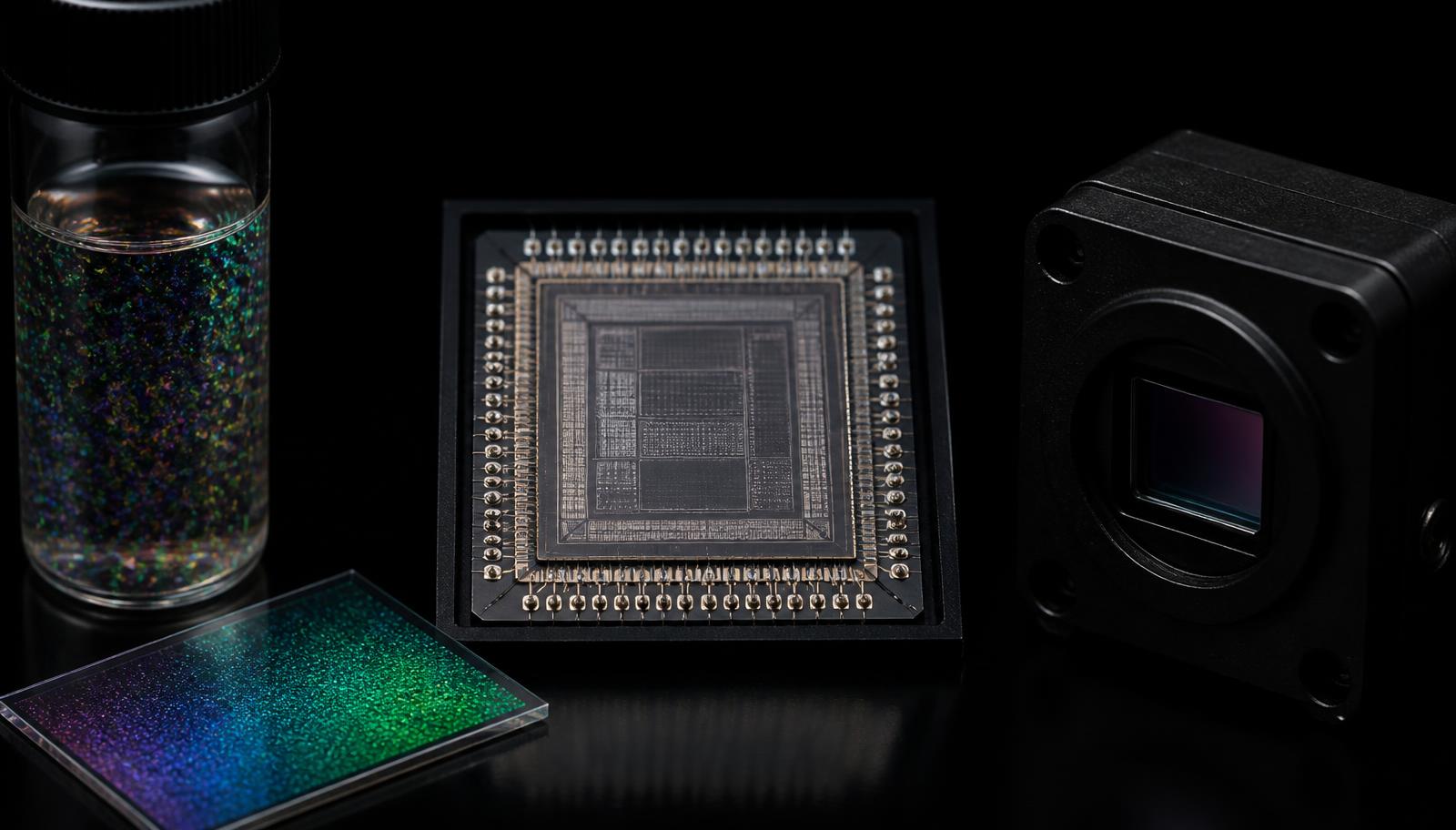
Solution-processed colloidal quantum dots, centered on HgTe/HgSe materials research, formulated for mid-wave infrared response.
Material deposited directly onto a silicon readout integrated circuit, designed to remove the separate detector chip and bump-bonding steps.
A smaller, more manufacturable sensor architecture with reduced cooling requirements, sized for small uncrewed platforms.
Affordable thermal sensing makes 24-hour autonomy possible.
Thermal imaging is the missing capability between a cheap daytime drone and a system that can maintain awareness in darkness and visually degraded conditions. Night-capable FPV and uncrewed operations are expanding rapidly, but thermal payload cost remains a bottleneck to putting that capability across large, expendable fleets. Sentinel is built to make advanced sensing available at the scale of the platforms now reshaping defense.
One sensing breakthrough. Many demand signals.
- Department of the Navy
- Army and Marine Corps uncrewed systems
- Air Force and Space Force sensing programs
- Counter-UAS
- Defense primes
- Emergency response
- Energy inspection
- Infrastructure security
The Department of the Navy has identified improved MWIR imaging as a strategic technology need. TASC is using that demand signal to build a larger infrared-sensing company.
The same cost and size problem matters to Army and Marine Corps uncrewed systems, Air Force and Space Force sensing programs, counter-UAS, defense primes, emergency response, energy inspection, and infrastructure security.
World-class materials science with a product path.
Sentinel is built through TASC's strategic university research network. UCLA's Caram Lab provides the infrared-nanomaterial foundation, including highly emissive HgTe quantum-dot research that creates a differentiated starting point for the MWIR challenge. TASC connects that science to sensor architecture, embedded electronics, platform integration, and defense commercialization.
UCLA holds the underlying university IP; TASC has an option and first right to negotiate an exclusive commercialization license as the technology matures.
Materials to modules to fleets
Prove materials performance and the direct-on-silicon sensor architecture.
Build compact sensor modules and prove integration on uncrewed and aerospace platforms.
Transition through drone OEMs, payload integrators, and defense primes.
Scale through module supply, application-specific licensing, and dual-use sensing markets.
The model is capital-efficient by design: TASC owns the product, integration, customer-transition, and commercial layer, while specialized research and manufacturing partners provide deep technical leverage.